
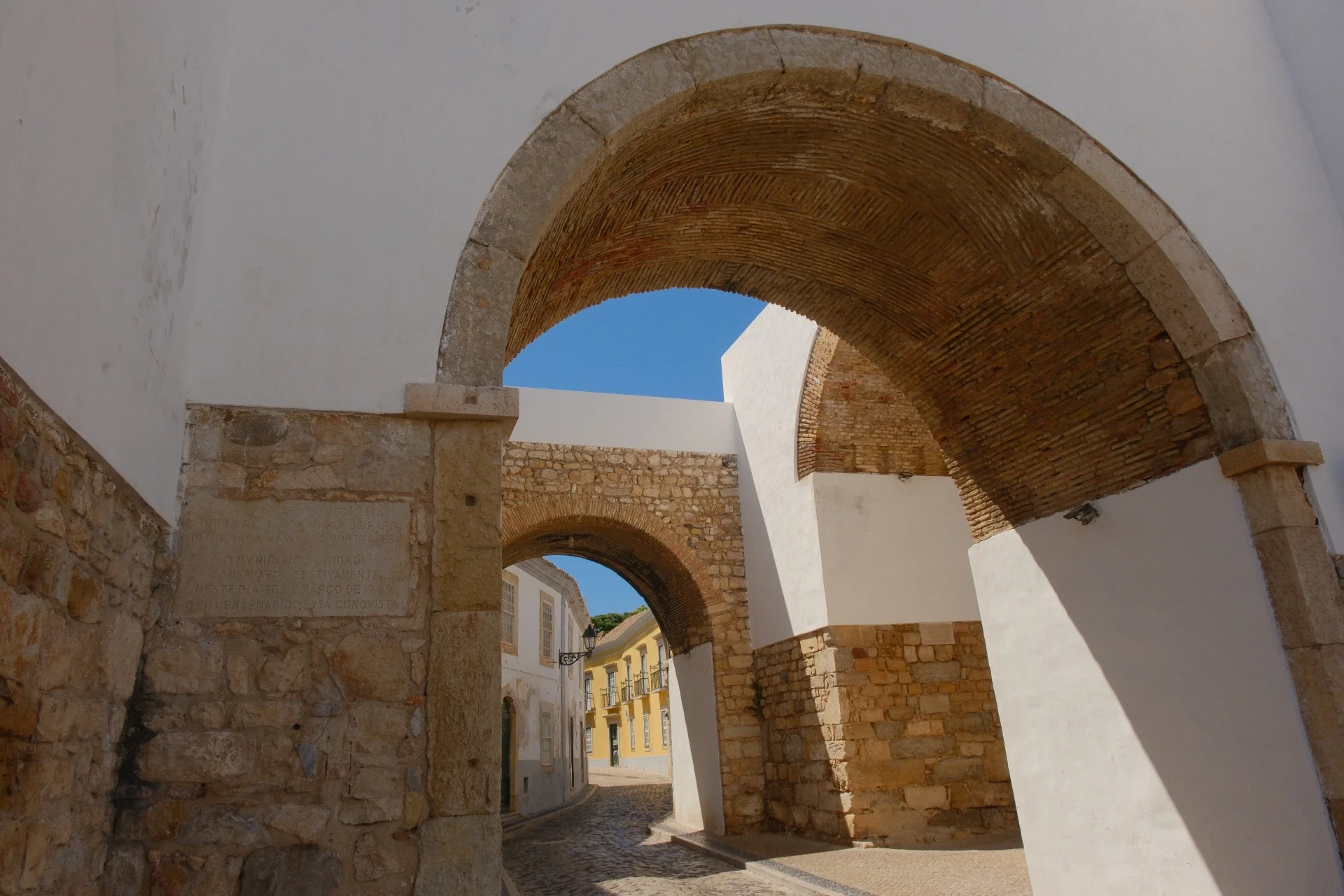
The Arco do Repouso: A Historic Gateway in Faro
Nestled in the heart of Faro’s Old Town — the walled quarter locals still call Vila-a-Dentro — the Arco do Repouso stands as one of the city’s oldest and most evocative monuments. More than just an archway, it is a physical record of nearly a thousand years of conquest, faith, and legend, layered stone upon stone into a single, unassuming gate.
The Walls Around Arco do Repouso: Built and Rebuilt Across Centuries
Faro’s city walls are far older than the arch itself — their origins trace back roughly two thousand years to Roman times, when the settlement of Ossonoba first took shape on this stretch of the Algarve coast. But it was under Arab rule, particularly during the 9th to 11th centuries, that the walls were substantially rebuilt and expanded into the oval circuit that still defines the old town today. The Arco do Repouso, constructed during the Almohad dynasty in the 12th century, was one of the principal gateways piercing that circuit — a working entrance through which merchants, soldiers, and pilgrims once passed, and one of the points where the city was, quite literally, at its most vulnerable.
That vulnerability did not go unnoticed. In the 13th century, as the Christian Reconquista pressed further south and the threat to Faro grew more immediate, the Moors reinforced the gate with two albarran towers — a distinctly Islamic military innovation. Rather than sitting flush with the wall, these towers projected slightly forward and outward, with entrances set to the side. The effect was devastatingly simple: anyone who managed to reach the gate itself could be attacked from behind by defenders positioned in the towers, a form of “passive counter-attack” that made the Arco do Repouso one of the best-defended points in the entire city wall.
The Fall of Faro — and How Arco do Repouso Got Its Name
The defenses held until 1249, when King Afonso III, accompanied by the Knights of the Order of Santiago, took Faro from its Moorish rulers — one of the final acts in the reconquest of the Algarve, and by some accounts the last stronghold to fall in mainland Portugal’s reconquest overall. Tradition holds that the city changed hands with unusual restraint, without the bloody sacking that so often followed a siege in this period.
It’s from this moment that the arch takes its name. According to the most enduring legend, the king and his exhausted troops rested here immediately after the conquest — and during that rest, an apparition of Our Lady is said to have appeared to Afonso III. That vision would, centuries later, give rise to the devotion housed inside the arch itself: Nossa Senhora do Repouso, Our Lady of Rest.
A second, more romantic legend tells a very different story. A Moorish governor’s daughter, so the tale goes, fell secretly in love with a young Christian knight from the besieging army. When her father discovered the affair, he denounced her as a traitor and, in his fury, enchanted her — condemning her to remain bound to this spot for eternity. One especially vivid retelling adds a haunting final image: a Christian officer, carrying the young Moorish woman in his arms as he fled the gate, looks down only to find her form dissolving into rags in the breeze, the girl gone as if she had never existed at all.
Whichever version one prefers, both legends fix themselves to the exact same stones — a rare case where folklore and formal history point to precisely the same doorway.
The Chapel Inside Arco do Repouso
The devotion to Our Lady of Rest eventually outgrew a simple roadside niche. In 1709, under the patronage of Queen D. Mariana of Austria, a proper chapel — the Ermida de Nossa Senhora do Repouso — was built into the inner chamber of one of the two albarran towers, replacing the earlier shrine that tradition says had been commissioned by Afonso III himself as a vow of thanksgiving. The queen’s involvement wasn’t merely symbolic: in September 1710 she granted the municipal council a fixed income specifically to help fund the chapel’s upkeep and worship. By 1729, the city council itself had taken on the role of protector of the image, forming a lay brotherhood whose membership included every sitting councilman.
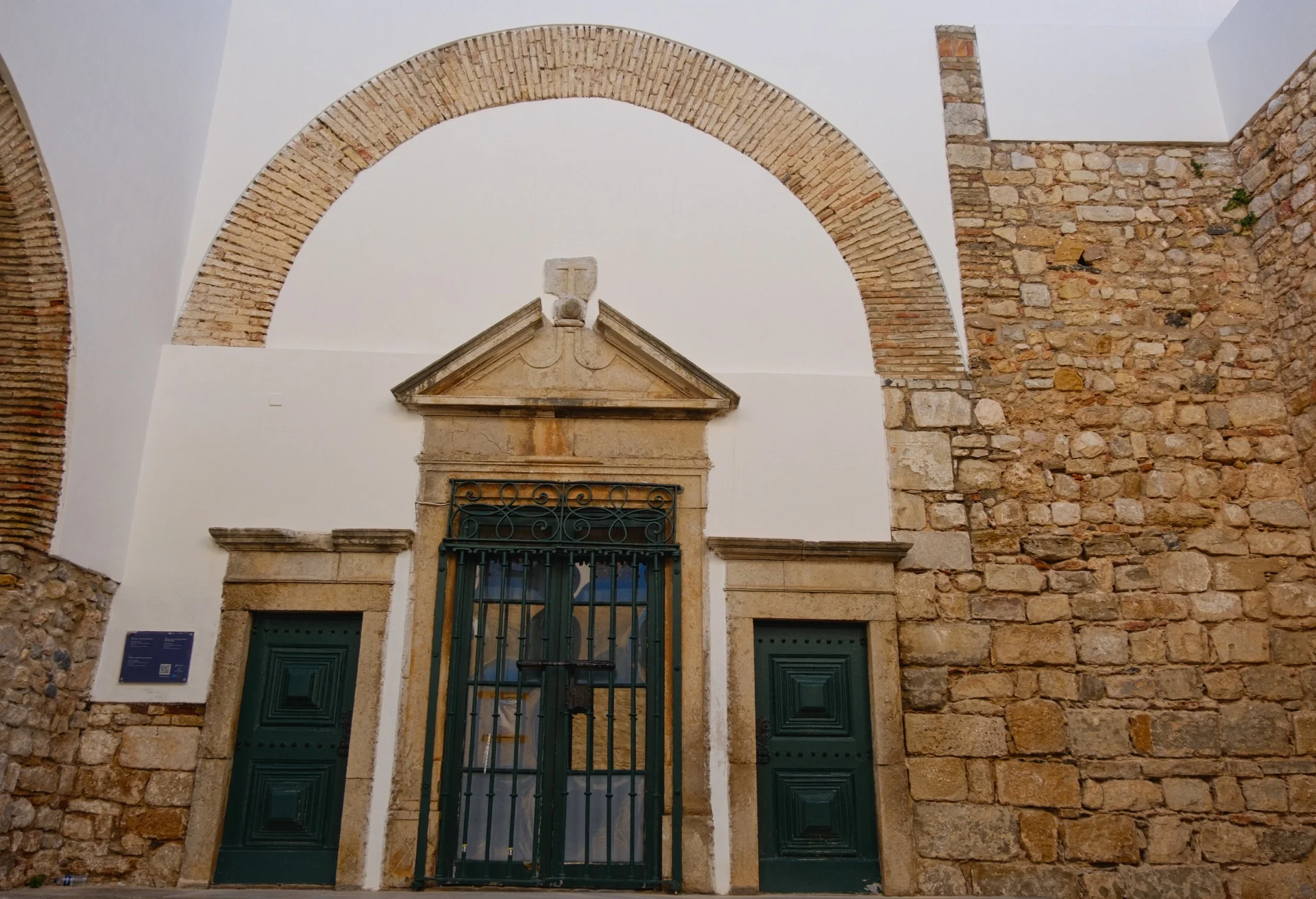
In 1730, master mason Teodósio Pereira reworked the chapel’s façade, modelling it on the original front of the nearby Igreja de São Francisco — a small but telling detail that ties this modest gatehouse chapel stylistically to one of Faro’s grander churches. Around 1800, a wooden altarpiece was installed inside, itself a survivor, repurposed from an earlier 17th-century church elsewhere in the city. The chapel’s main façade sits above a small landing reached by a short stairway, with passing water running beneath it, and is marked by three stone portals with straight-rod architraves — the taller central one crowned with a broken triangular pediment, a crucifix, and wrought-iron grilles. Inside, a sculpted panel and side walls painted in blue-toned wood complete the space.
Arco do Repouso: Where Empires Met
What makes the Arco do Repouso genuinely remarkable isn’t any single feature, but the collision of eras visible in one small footprint: Almohad military engineering, a Christian conquest legend, an 18th-century Baroque devotion, and a folk tale about forbidden love, all sharing the same handful of stones. Few monuments in the Algarve compress so much of the region’s layered history — Roman, Moorish, Christian — into a structure you can walk through in a matter of seconds.
Visiting Arco do Repouso Today
The Arco do Repouso sits on Rua do Repouso, one of the access points into Vila-a-Dentro, Faro’s walled old town, and remains freely accessible to the public at any hour. Like much of the city’s medieval fabric, it has been altered by various restoration campaigns over the centuries — not always with strict fidelity to the original Almohad stonework — yet it endures as one of the best-preserved examples of the city’s military architecture from that period.
A visit here pairs naturally with the rest of Vila-a-Dentro: the Sé Catedral de Faro and its bell tower views over the Ria Formosa, the Museu Municipal housed in the former Convento de Nossa Senhora da Assunção, and the quiet cobblestone streets that still trace the outline of the medieval city the arch once helped defend.